Current Issue
Our Partners




P3 1-2/2025 en
Folding Cardboard Inlays
Compact Gripping and Folding Unit Developed Specifically for a new Cardboard Tray Former
Research & Innovation
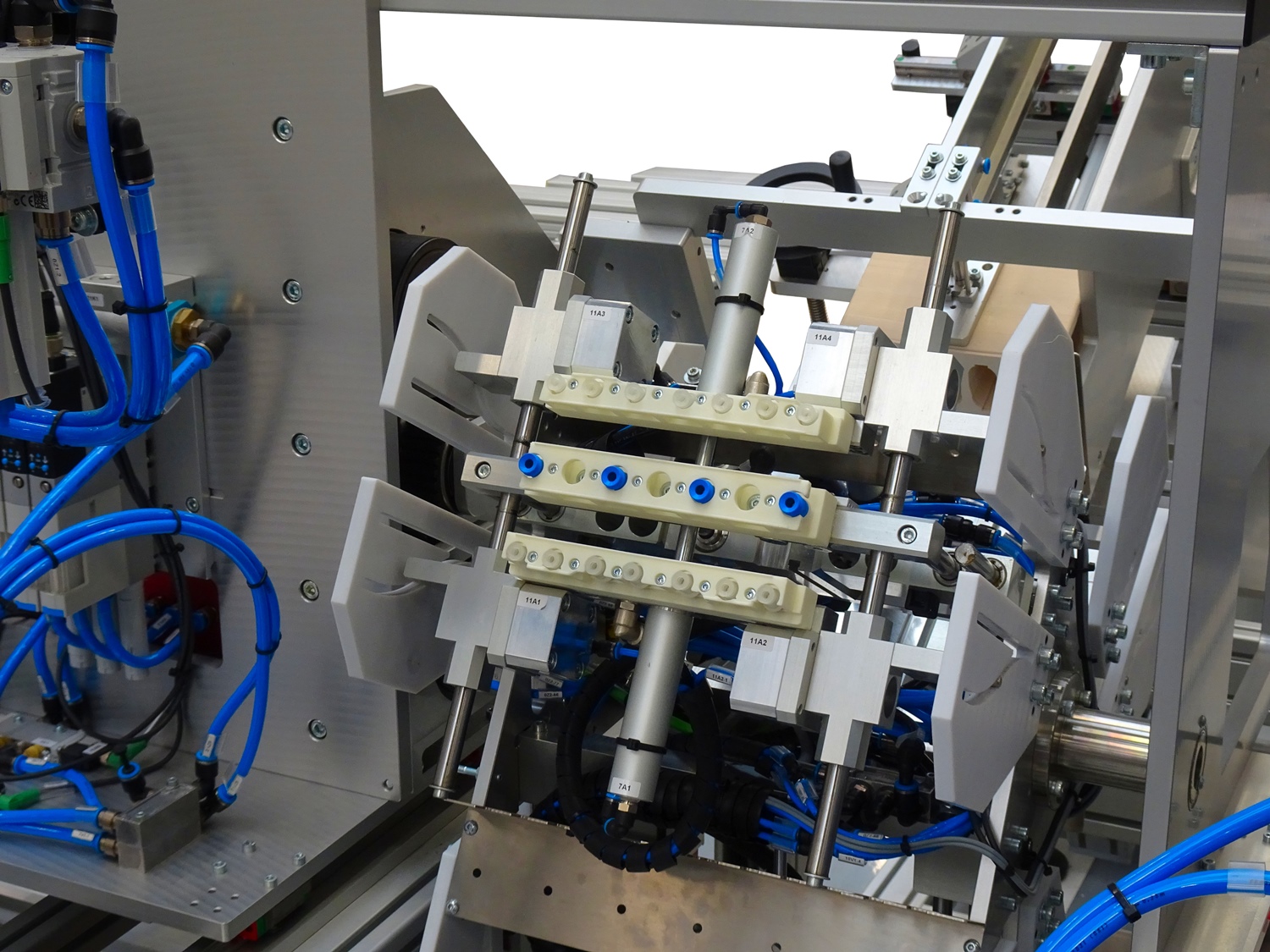
To ensure that the complex gripping and folding unit is as compact as possible, the double-acting cylinder does not travel the full 120 mm lengthwise, but is divided into two strokes of 60 mm each.
They are hygienic, durable, lightweight and reliably protect medicines and instruments from contamination: plastic containers are indispensable in the medical and pharmaceutical industries. However, the material itself is not biodegradable, is often only recyclable with a loss of quality, and even more frequently ends up in residual waste. To implement sustainability goals in medical sectors as well, it is necessary to reduce the use of plastic as much as possible – for example, in packaging inlays. The problem with this is that folding cardboard trays has so far been significantly more complicated and expensive than producing their plastic counterparts. With the new cardboard tray former from Kraus Maschinenbau, however, inlays in various formats can now be produced efficiently. To design the system flexibly and in a space-saving manner, it is equipped with two special gripping and folding units, which the pneumatics specialist Konstandin developed specifically for this purpose. To ensure that this complex assembly is as compact as possible, the double-acting cylinder does not extend the full 120 mm lengthwise, but is divided into two strokes of 60 mm each. A sensor-monitored rotary union from the same manufacturer reliably supplies the system with compressed air and electricity.
To ensure that the complex gripping and folding unit is as compact as possible, the double-acting cylinder does not travel the full 120 mm lengthwise, but is divided into two strokes of 60 mm each.
“Many industries have now realised that implementing sustainability goals is not just a ‘must’, but actually pays off for individual companies,” says Patrick Hermann, Head of Design and Development at Kraus Maschinenbau. “In the medical and pharmaceutical industries, however, this process is progressing slowly – even though there is so much potential, especially in terms of waste reduction.” With numerous medical products such as sterile packaging, blood bags or flexible components like tubing, plastic is often unavoidable. In the case of less critical applications, however, the situation is different: many components such as outer packaging or inlays can easily be made from paper or cardboard, which place significantly less strain on the environment during production and disposal.
But why has this so rarely been the case in practice so far? Hermann has an answer ready: “Cardboard packaging has so far been more expensive to produce because folding and shaping require more complex work steps, and most companies first have to invest in new systems for this.” However, in recent years, Kraus Maschinenbau has observed an increasing demand for exactly this. Many manufacturers are interested in producing conventional trays for medical products such as medicines, ampoules and syringes from cardboard at low cost. Therefore, the machine manufacturer began developing initial concepts for the new cardboard tray former in 2020.
Patented assembly for separating, folding and combining
The cardboard tray former consists of four segments: at the beginning, there is a feeder for the still-flat cardboard blanks that form the supporting frame of the trays. These pass through a gluing station before cut-outs for the recesses are inserted, folded and placed into the supporting frame in another feeder. The finished trays are then stacked for removal or, as needed, transferred to downstream systems for filling with products. The entire process is fully automated. “The complex unit for separating, folding and combining the individual cardboard components is a completely new design that we have already applied for a patent for,” adds Hermann.
However, to ensure that the entire line, measuring approximately 6,400 x 2,800 mm, was not too large, the new development required particularly sophisticated pneumatics. For this, Kraus Maschinenbau turned to its long-standing business partner Konstandin. “The challenge was not to cobble together a complex assembly from several components, but to design it from scratch as a single unit to meet the strict requirements,” explains Mathias Kraft, Technical Manager at Konstandin. “Among other things, it had to be as light and compact as possible, have a low centre of gravity and allow for movement in several directions as well as stops.”
Compact pneumatics with extra damping
The first hurdle Konstandin had to overcome with the gripping and folding unit was to make the cylinder housing as small as possible. With the required stroke length of 120 mm, the entire structure would have been far too large, necessitating a redesign of the system and inevitably requiring more space and increased material costs. “However, we divided the stroke into two 60 mm movements so that it moves one step upwards and one step downwards lengthwise,” reports Kraft. “This allowed the housing to be built half as large.” A cam disc was also used to realise not only the double-acting longitudinal stroke but also a transverse stroke, which is responsible for clamping and folding the cardboard. To prevent the components for the transverse stroke from moving on their own due to rotation, the cylinder operates with particularly low back pressure.
The rapid cycle times required by Kraus Maschinenbau also presented the developers with challenges. A cycle should not exceed approximately one second. For the pick-up movement, this consists of extending, suction, retracting and rotating by 120 degrees; the placement movement involves clamping, extending, retracting and rotating. However, due to the high speeds when reaching the end positions, impacts occur that inevitably place heavy stress on the components. To increase the durability of the components nonetheless, the strong forces are absorbed by special damping discs. Additionally, the screw connections were specifically secured against unintentional loosening.
A step towards greater sustainability
In addition to the gripping and folding unit, Konstandin supplied special rotary unions for the new system, which provide the system with compressed air for movement, vacuum for the suction device and electricity for the piston end-position switches. Due to their modular design, the rotary unions are equipped with a leakage channel, which allows seal wear to be monitored using sensors. “This makes it possible to plan maintenance in the long term,” explains Kraft. “At the same time, there are no unpleasant surprises with the media supply that could impair operations.”
The development process for the complex assembly took only two months. Thanks to the smooth collaboration with Konstandin, Kraus Maschinenbau was finally able to present the new cardboard tray former for the first time at Pharmintech in Milan in spring 2022. “The feedback was consistently positive,” recalls Hermann. “There is undoubtedly strong demand for sustainable packaging that is in no way inferior to conventional plastic moulded parts in terms of performance. With the cardboard tray former, we are now offering companies the right tool for this.”
Further information at https://www.krausmb.de/ and https://konstandin.com/.
Since 2008, Kraus Maschinenbau GmbH has been developing and manufacturing high-precision feeding systems and complete solutions for various applications and industries. The components and systems are used worldwide in print and logistics, warehouse and automotive automation, as well as in the pharmaceutical, hygiene and food industries. The company places great importance on sustainability: wildflower meadows for insects buzz with life around the company building, while a photovoltaic system on the roof collects valuable solar energy, enabling the business to operate largely autonomously. When developing and designing customer projects, the company uses state-of-the-art, energy-efficient components and packaging materials that are as fully recyclable as possible.
Konstandin GmbH was founded in 1975. The family business is now managed in the second and third generations by managing directors Jörg and Jonas Konstandin. The Baden-based company develops, produces and distributes technical components and systems, as well as customer-specific special solutions in the fields of pneumatics, hydraulics and vacuum technology. The extensive product portfolio ranges from cylinders to rotary unions, compact controllers and control cabinets. Konstandin’s headquarters are located in Karlsbad-Ittersbach, covering an area of 3,300 m². The company, which also operates as a training organisation, employs a total of 40 permanent specialists.
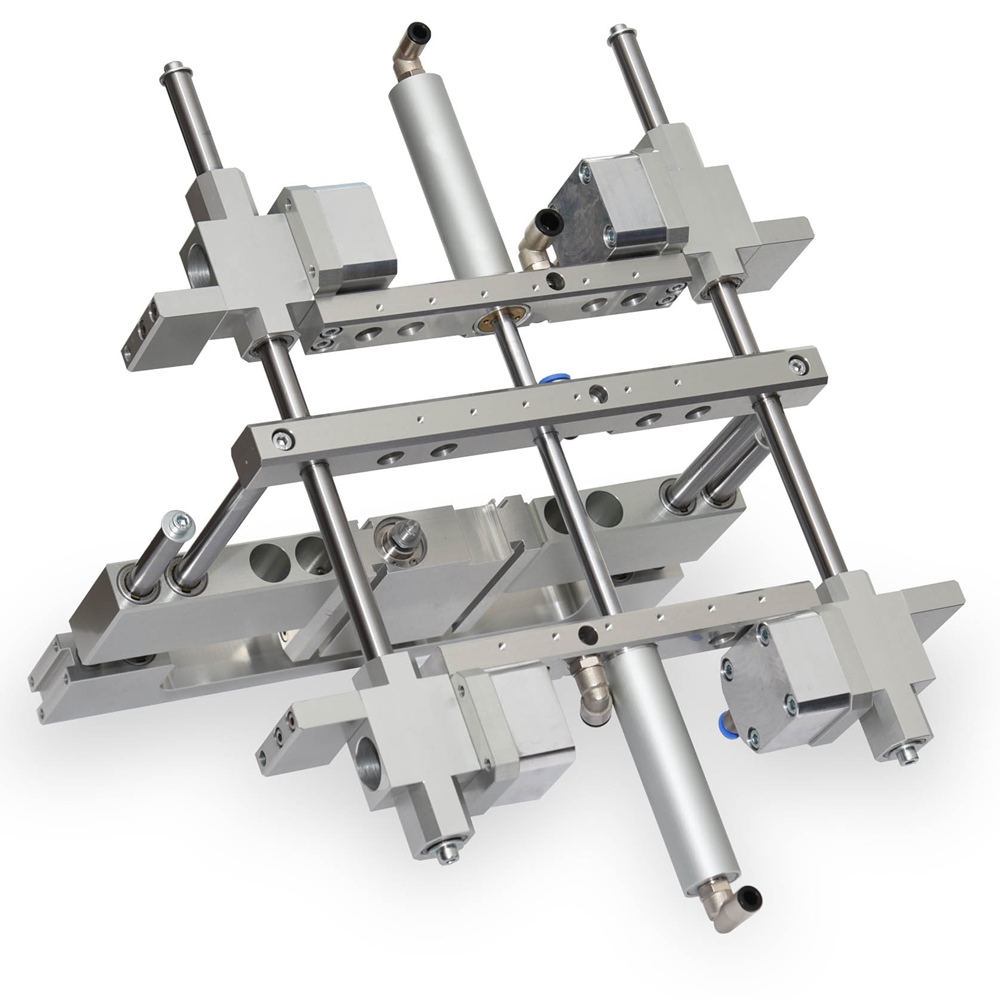
The development process of the complex assembly took only two months.
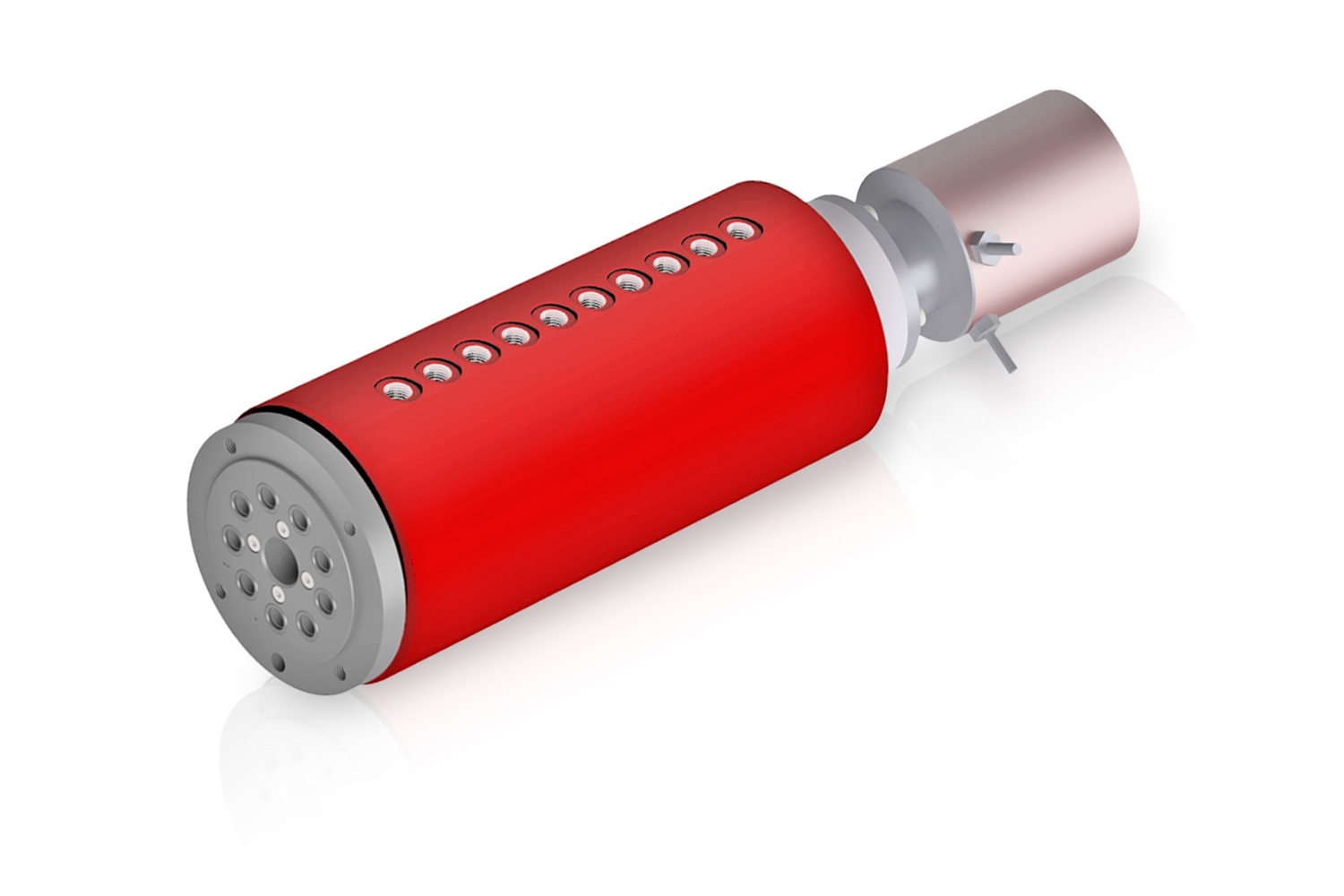
A sensor-monitored rotary union from Konstandin supplies the system with compressed air and power in a fail-safe manner.
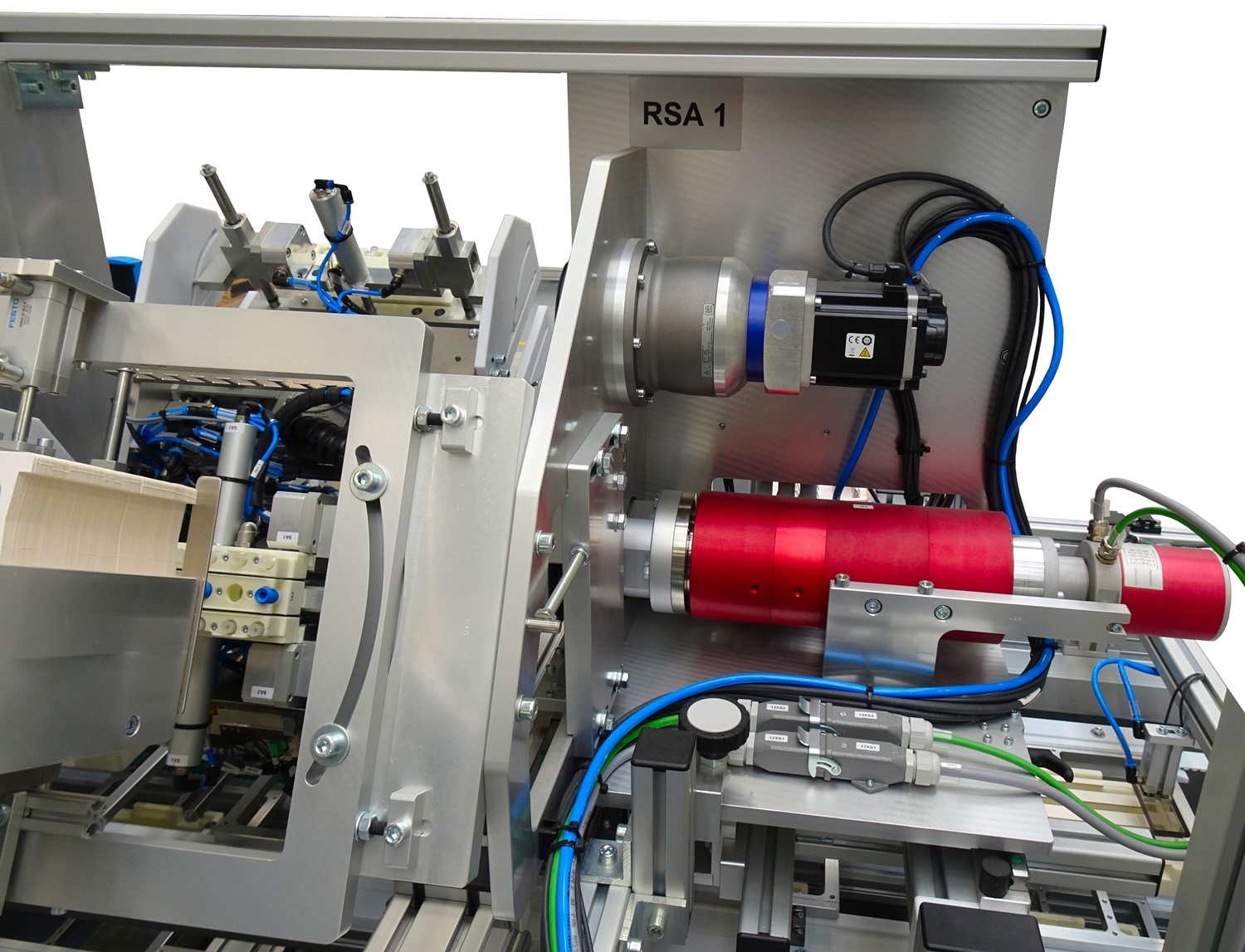
In order to be able to design the carton tray former flexibly and in a space-saving manner, the system has two special gripping and folding units that the pneumatic specialist Konstandin has developed specifically for this purpose.
Editor: sbr
Images: Kraus Maschinenbau [1,4]; Konstandin [2,3]
Content

