Current Issue
Our Partners




P3 7-8/2024 en
Discourse
Good Cop – Bad Cop
The Unusual Print Product
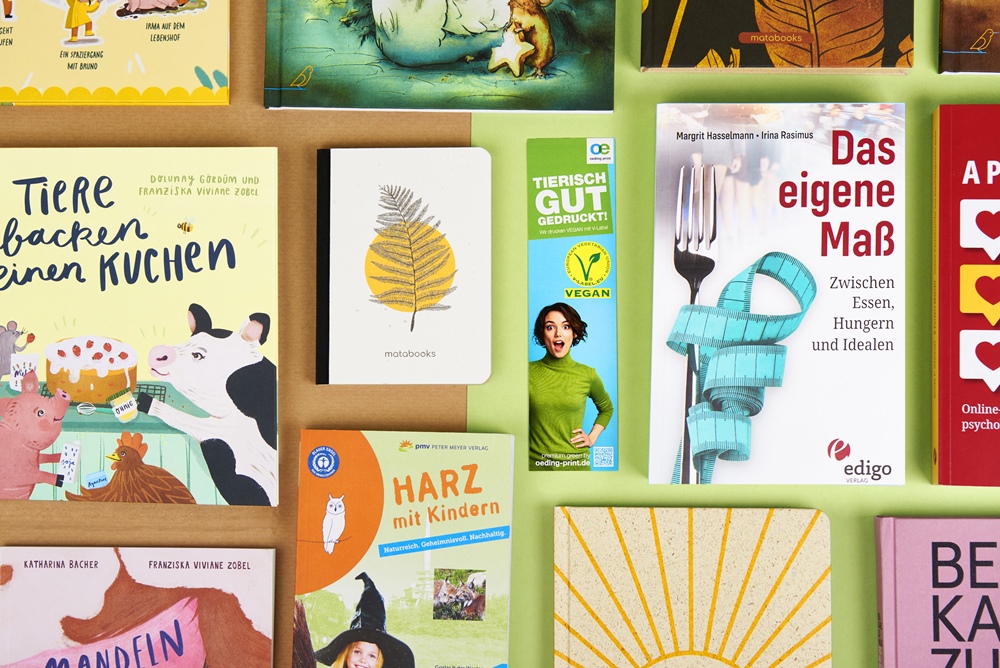
Not for “late medieval stubbornness”: Vegan book production.
Let's assume - purely hypothetically, of course - that I actually had no understanding of vegan printing (still not). Let's also assume that I had prejudices. Then I would be in exactly the right, comfortable position here: as an advocate of good old, Christian-social book printing of late medieval origin. Because let's be honest: we really don't need everything! Vurst, Vekse and Vozzarella - at some point it has to stop! Right?
What follows is a friendly (as was agreed) dispute with none other than Roland Makulla, Head of Sustainability and Certifications at oeding print GmbH in Braunschweig.
Not for “late medieval stubbornness”: Vegan book production.
Stefan Breitenfeld: Mr. Makulla, in the last few months I have had several opportunities to speak to other people about the topic of vegan book printing - among family and friends, on airplanes and in the eternally delayed Deutsche Bahn trains. Mind you, the approach was completely value-neutral. The reactions went one hundred percent in one direction: steeply downhill. From the uncomprehending “Do we really have nothing else to worry about?” to the “windshield wipers without cleaning fluid”. Lack of awareness or simply a lack of need?
Roland Makulla (laughs): Dear Mr. Breitenfeld, we both know that with the topic of vegan book production we are not addressing the mass market, but rather specific target groups. But hey, we have experienced similar reactions from normal visitors to the Leipzig Book Fair, for example. However, if you formulate the question a little more specifically - for example: “Wouldn't it be consistent to print a vegan cookbook as vegan?” - and open a packet of gelatinous glue (bone glue), which is used in industrial book production to apply the cover to the book cover, the answers could probably be a little different.
Stefan Breitenfeld: I'm not going to get involved with the “normal visitors” in Leipzig - that smells too much like a trap to me. But speaking of smell: freshly pressed bone glue (editor's note: yes, I know.) is certainly anything but an olfactory revelation. Nevertheless: my bookshelves contain over 800 books and it doesn't smell like an ossuary here - on the contrary. And the dishes from non-vegan cookbooks don't taste any worse. To stay in the jargon: this soup is still a little too thin for me. Which “specific target group” responds to such wooden club arguments?
Roland Makulla: Do I sense a certain late medieval stubbornness here, to acknowledge that the world has changed and that there are people who avoid animal products out of conviction - be it food, cosmetics, clothing, etc.? That is currently our target group, and “consistency” certainly plays a role here.
Our customer portfolio mainly includes publishers. By the way: We are by no means a proselytizer. Interested parties mostly come to us of their own accord because they are specifically looking for suitable alternatives for their print products. You can find a blog with some examples on our website: https://www.oeding-print.de/produktbeispiele-vegan-drucken/.
Stefan Breitenfeld: Ah - now we're firing shots. “Late medieval stubbornness” of course always suggests a latent lack of education and enlightenment. I don't want to linger in this corner. Good. So we have a target group. Now publishers are not known for sitting idly by and waiting for customers. The question therefore remains whether this market niche is real. To put it another way: does the range of vegan printed products serve more than just a need artificially created by clever marketing? Or are we talking about a trend that could have an expiration date? I also ask this question with a view to the cost structure. Can vegan (book) printing compete with conventional processes? Vegan products are often in a different price range in retail ...
Roland Makulla: I meant late medieval in terms of book printing and not IQ (laughs).
In terms of costs, we have to differentiate between the product groups. Our production is so standardized in terms of the materials used that all standard printing and auxiliary materials meet the criteria of the V-Label and the Blue Angel. This means that the choice of paper alone determines which label we can print on request. This standardization also extends to external processing, such as thread stitching and adhesive binding. In terms of production, there are no additional costs for vegan printed products in these product groups.
The situation is currently different in book production: Here, the processors have to use special adhesives for the book cover. This requires additional set-up times and the processing speed is overall slower than when using gelatinous adhesives. This is clearly reflected in the price of books.
As usual, the V-Label also incurs fees for testing and license use. However, these costs are manageable and, when allocated to the orders, only cause marginal additional costs.
The impetus to offer vegan printed products came from the market. Around five years ago, growing demand prompted us to get involved in this topic and develop a new industry standard together with the V-Label. Several printing companies are now certified, and the Spinner bookbinding company is also the first certified processor. We will have to wait and see whether this is just a trend. At the moment we are all still doing pioneering work with the associated challenges.
Stefan Breitenfeld: Ultimately, that means - and I don't want this hypothesis to be taken provocatively - you would like more competition? More suppliers mean more investment in methods and process technology as well as a better negotiating position when it comes to supplier products (keyword: adhesives). More market leads to falling prices - if the conventional market economy model is still applicable today. Is such market growth realistic or is vegan (book) printing still a bit of a risk for the time being?
Roland Makulla: It is precisely for this reason that we have developed a universal and open industry standard for vegan print products together with the V-Label and actively supported other printers in their certification in order to establish the topic more firmly on the market. Because although there are now products without animal ingredients for most printing and auxiliary materials, we are reaching our limits when it comes to the topic of stitching wire, for example: With the current manufacturing processes, stitching wire is not vegan. This means that we cannot currently offer saddle stitching with the V-Label - and this means that a lot of potential is lost in the area of ??brochures and magazines. The more printing companies are certified, the greater the demand for vegan stitching wire - and with it the incentive for manufacturers to use alternative drawing materials in production increases. And of course, innovation always means a certain amount of risk. We were aware of this risk from the start and planned accordingly. Incidentally, a similar development occurred after the introduction of the Blue Angel for printed products (DE-UZ 195): Here too, the growing demand ultimately led to many manufacturers adapting their products to the Blue Angel's specifications and cooperating on the necessary evidence.
Stefan Breitenfeld: I think that's a good final word - and I'm converted enough to stick with the topic in the future - because it is definitely an issue. Please extinguish my pyre after I've opened your handcuffs. Thank you!
Roland Makulla: I think your (print) black humor is just great, thank you very much for the exciting exchange and wish you and your loved ones happy holidays – with sausage soup or tofu goose!